
AI lets Non-Programmers to Ship Software with Ease

The headline number is the story. A third of the people shipping software with AI have no formal programming background — no CS coursework, no prior role as a developer. Five years ago, "build me a dashboard that analyzes customer complaints" was a project request. Today it's a prompt. That's not a forecast. It's already in production at companies you can name.
Zapier surveyed roughly 800 U.S. employees who've built or deployed tools with AI coding apps. The headline finding — that 34% of people shipping software using AI tools have no formal programming background — isn't a vibe-coding anecdote. It's a workforce signal. The same survey found that more than half of those non-traditional builders ship tools for customers or the general public, and 54% say their tools are still in use today. These aren't weekend prototypes. They're load-bearing software.
What the survey actually measures
This isn't a poll of curious tinkerers. Zapier filtered for people who had built or deployed tools with AI coding apps at work. The 34% number sits on top of that filter. So out of the population already shipping, more than one in three learned to do it without a CS degree or a developer job title.
Three more numbers from the same survey matter:
- More than half of non-programmer builders create tools for customers or the general public — not internal dashboards, not toys. External users.
- 54% of non-traditional builders say their tools are still in use today. They're not throwaway experiments.
- 20% of non-traditional builders say this skill snagged them a promotion or a raise. The orgs noticed.
The vibe-coding label undersells the work. The vibey part is the input — plain language, one afternoon. The output is software that ships and stays shipped.
The mechanics — how a non-developer ships in an afternoon
The mental model is wrong if you think of AI tools as autocomplete. The workflow that produces shipping software from a non-programmer looks like this:
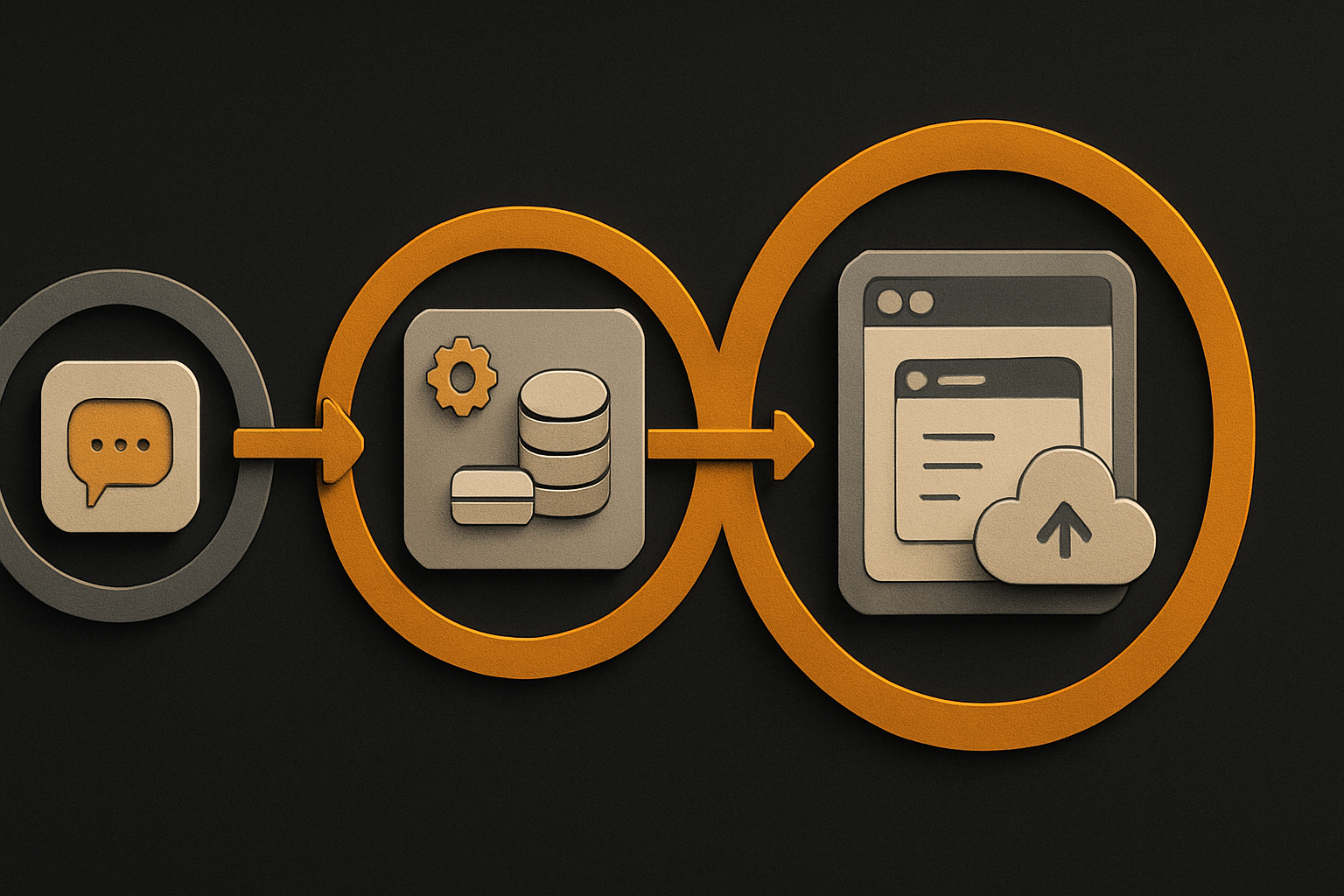
Three layers, each with a different tool. The Zapier data confirms this is what real builders actually use:
- 82% use general-purpose chatbots like ChatGPT or Claude. This is where you describe the problem in plain language and shape the architecture.
- 71% use AI coding assistants inside existing coding tools, like GitHub Copilot. This is where the assistant writes and edits code inside an editor.
- 40% use dedicated AI coding software like Cursor. This is the integrated environment — the whole loop in one place.
The chatbot does the thinking. The coding tool does the typing. The non-programmer does the prompting, the testing, and the deciding-when-it's-done. That's the actual division of labor.
A non-programmer describes a dashboard for analyzing customer complaints. The chatbot returns a plan — what to query, what to chart, what filters to expose. The coding assistant writes the code. The non-programmer runs it, screenshots the bug, types "the date filter is off by one day", and the assistant fixes it. Repeat until the dashboard ships.
That's not magic. It's a tight feedback loop between three specific tools.
11 production screens. Login, database, payments — all wired.
The SaaS Dashboard Kit ships everything already connected. Nothing to set up. Live demo at saas.otf-kit.dev.
How to actually do this today
If you're a non-programmer who's never shipped software, here's the concrete path. Skip the philosophy; this is the receipt.
# 1. Describe the project to a general-purpose chatbot first.
#    Don't ask for code. Ask for the plan.
#    "I run a dental clinic. I want a page where patients can book
#     appointments and I can see the daily schedule. What should I
#     build? What does the data model look like?"

# 2. Take that plan into a dedicated coding tool.
#    Cursor is the most common entry point for non-programmers.
#    Install it, open a folder, paste the plan as the first prompt.
// Inside Cursor, the non-programmer's job is to prompt, run, and screenshot.
// Example prompts that actually work:
// "Add a calendar view to the dashboard. Group by week."
// "When the user clicks a date, show the appointments for that day."
// "Add an email field to the booking form and validate it."
// "Style the buttons with the clinic's blue (#1E5AA8)."# 3. Run the dev server and watch for errors.
cd my-app
npm install
npm run dev
# Open Screenshot anything that breaks.
# Paste the screenshot back into the chat with: "this is wrong, fix it".The three habits that separate the 34% who ship from the ones who stall: write the prompt in the shape of a finished thing ("a calendar view grouped by week"), paste actual error output, and iterate in small steps instead of asking for the whole app at once. Specificity beats ambition.
The catch — what AI doesn't solve
The 34% statistic is real and worth celebrating, but it doesn't mean the work is free. Three failure modes show up in nearly every non-programmer project that stalls:
- Prompt drift. The original goal gets lost after ten rounds of "fix this, change that." The chatbot optimizes for the latest instruction, not the original spec. Solution: keep the original goal pasted at the top of the chat, and re-anchor the assistant to it every few rounds.
- Hidden complexity. AI-generated code handles the happy path and breaks on the edge cases — empty inputs, bad dates, concurrent edits, auth failures. The non-programmer doesn't see these until users do. Solution: ship to a small group first and watch what they actually do.
- No durability plan. The dashboard works on the laptop it was built on. It doesn't survive a model swap, an API change, or a teammate trying to edit it. This is the gap that hurts the most.
That last point is the one most builders hit without warning. Vibe coding ships the prototype. Shipping it durable — something that survives when the model behind it changes, that runs on web and mobile without rewriting, that another person can pick up and edit — is a separate problem.
The part that doesn't change when the model does
Use the AI tools. The 34% number is a real tailwind, and the workflow above is how a non-programmer ships in 2026. The chatbots, the coding assistants, the dedicated editors — they're good, they're cheap, they're worth adopting today.
The part that doesn't change when the underlying tool churns is the shape of the software. A component that renders the same on web, iOS, and Android doesn't depend on which model wrote it. An accessibility tree the model can read doesn't depend on which prompt produced it. A validated config the assistant can lint against doesn't depend on which assistant you're using next quarter.
That's the durable layer. The model behind your dashboard will change — you'll swap Claude for something cheaper, Cursor for whatever ships next, ChatGPT for an in-house model. The components, the API surface, the structure the code lives inside — that's the part a builder owns, and it's the part that survives the swap. Build on top of a shape that doesn't move, and the tool churn becomes an upgrade, not a rewrite.
The 34% who are shipping software with no formal background aren't doing it because the AI is smart. They're doing it because they've stopped waiting for a developer to translate their idea into code. The next question isn't whether they'll keep shipping — it's what they'll ship that lasts.
Ship the product, not the setup.
- 11 production screens — auth, billing, team, analytics, settings
- Real database, payments, and login — all wired on day 1
- AI configs pre-tuned so your agent extends instead of regenerates